Why jazz and paddlewheelers belong together
Riverboat jazz: the history
How steamboats and New Orleans jazz grew up on one river: the Streckfus boats, Fate Marable, Louis Armstrong and what a band on a paddlewheeler is today.
Reserve a place on the river ↗Quick answer
New Orleans jazz and the Mississippi paddle steamer both took shape in this city. In the late 1910s the Streckfus excursion steamers hired New Orleans bands, led by Fate Marable, and Louis Armstrong played on them before he left for Chicago. Those boats carried the music upriver to audiences as far as St. Paul. A band on a paddlewheeler today is a modern echo of that history, not a re-enactment, and the programme is not fixed.
Two things that began in one city
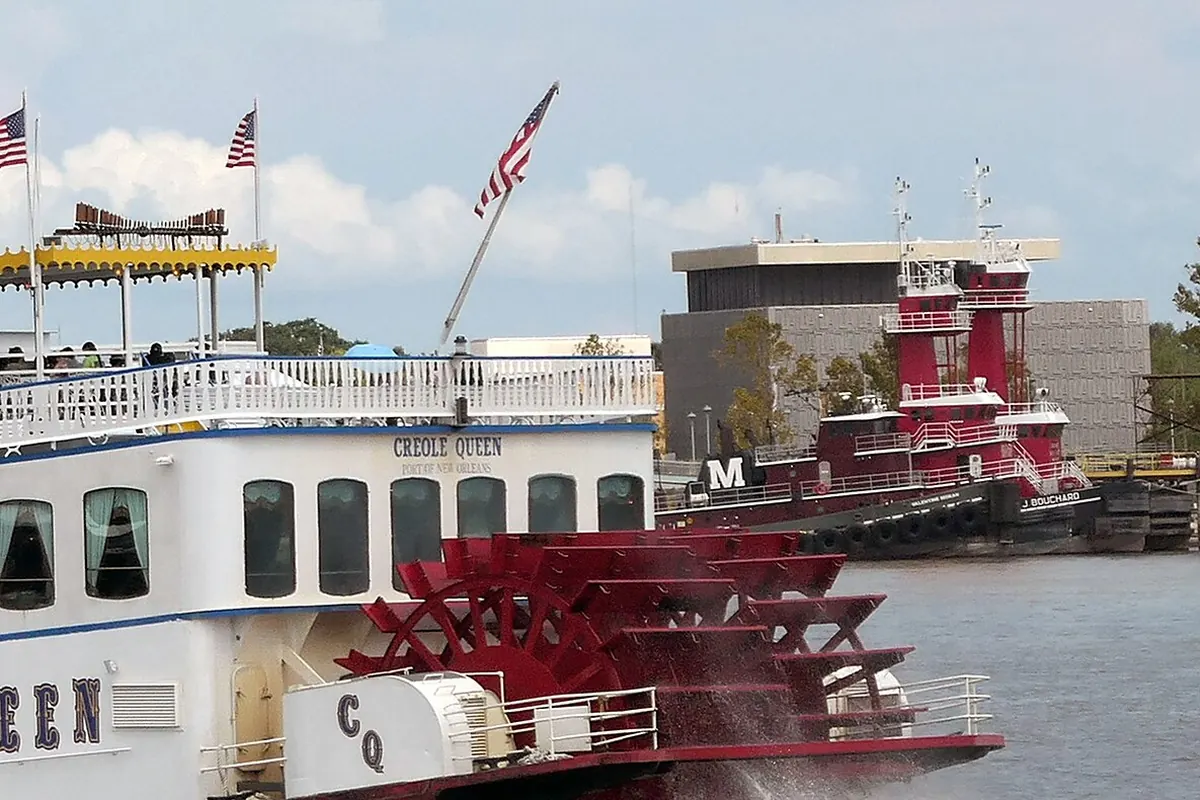
Jazz originated in New Orleans, in African-American communities, between the late 1800s and the early 1900s. The Mississippi paddle steamer, in its American form, also began here: the first one on the river started operating out of New Orleans in 1812. The two met on the water within a few generations, and the evening cruise sits where they overlap. An evening of live jazz on a paddlewheeler therefore rests on real history, and the rest of this guide follows that history from the boats to the bandstand, and then back to the deck you can board tonight. Read the sections in order: boats first, then bands, then the evening you can actually book.
How the steamboat came to the river
Robert Fulton's Clermont, possibly the first commercial success, entered service between New York City and Albany in 1807. In 1811 a line of river steamboats left Pittsburgh for New Orleans by way of the Ohio and the Mississippi, and in 1812 the first Mississippi paddle steamer began working from the city. By 1814 Captain Henry Shreve had developed a steamboat suited to local conditions, and the term stuck for vessels on the Mississippi system. Landings at New Orleans rose from 21 in 1814 to 191 in 1819 and to over 1,200 in 1833, a measure of how quickly the river changed. Steamboats became a preferred way to travel in the early 1800s because they were faster and more comfortable than going overland by horse, wagon or foot.
The sternwheeler explained
A sternwheeler carries one paddle wheel at the back. The wheel is a large steel framework fitted with regularly spaced blades, and roughly the lowest quarter of it turns under the water. The first sternwheelers were invented in Europe, but they saw most service in North America, especially on the Mississippi, and a boat called Washington, built in 1816, became the prototype for the Mississippi steamboats that followed. Later propellers largely replaced paddle wheels, which survive today on excursion boats, floating restaurants and replicas. The sternwheeler Sprague, built in 1901, was the largest and one of the last paddle steamers on the Mississippi.
Read next: The Mississippi bend by night
The pilot's call
Mark Twain worked as a riverboat pilot before he wrote about the river, and his book Life on the Mississippi came out in 1883. He recalled that the boys of his boyhood town wanted above all to be steamboatmen, and that the pilot held the grandest position. He also explained his pen name: “mark twain” was the call made when the boat was in safe water, a depth of two fathoms, or 12 feet. Twain described the pilot's prestige as greater than the captain's. When you hear the call quoted on a river evening, it comes from the working life of the boats.
Jazz before the boats
New Orleans jazz began in the early 1910s, combining earlier brass band marches, French quadrilles, biguine, ragtime and blues with collective improvisation. Its background is older: enslaved people gathered at Congo Square, famous for African dances, and cornetist Buddy Bolden played in the city from 1895 to 1906, though no recordings of him exist. The instruments of the marching bands and dance bands became the standard instruments of jazz, and Storyville, the red-light district around Basin Street, brought the music to wider audiences, including tourists who came to the port. The Afro-Creole pianist Jelly Roll Morton began his career in Storyville, and his Jelly Roll Blues, composed in 1905 and published in 1915, was the first jazz arrangement in print.
Read next: After the cruise: jazz on foot
The Streckfus steamers and Fate Marable
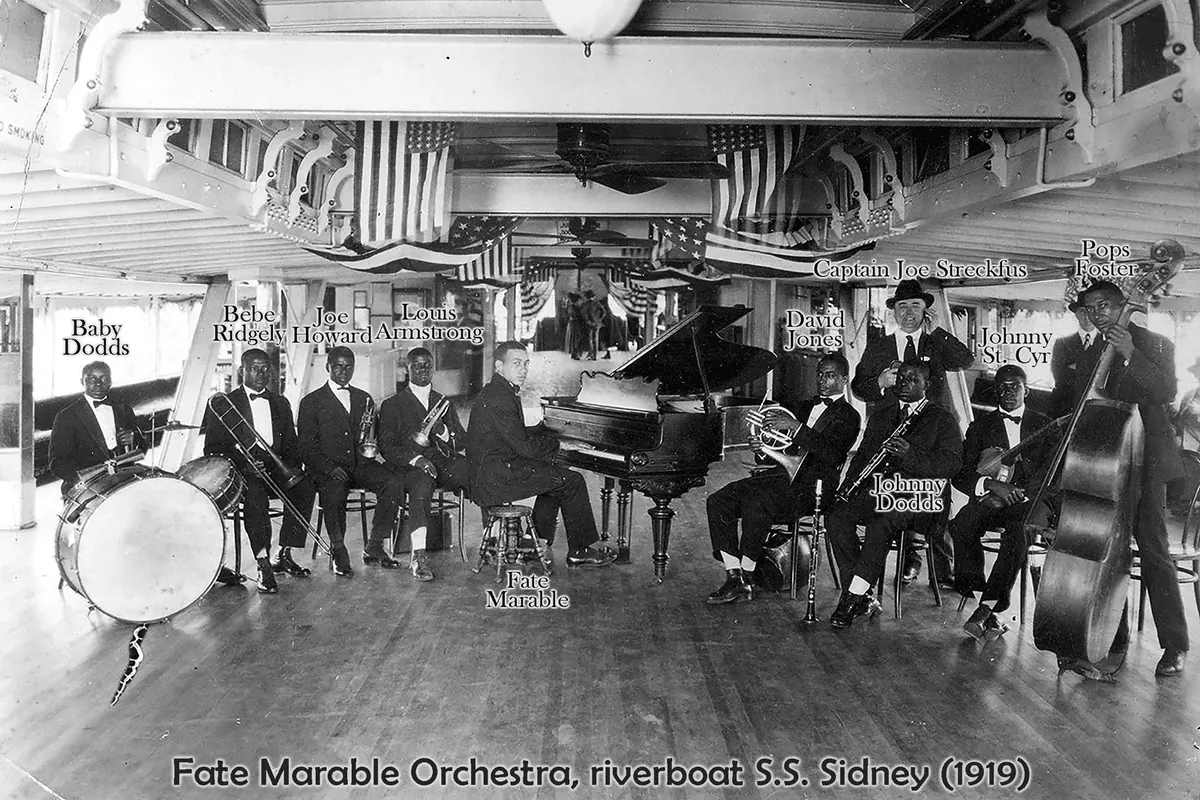
Fate Marable was born in Paducah, Kentucky, and began playing on Mississippi steamboats at 17. He was hired by John and Joseph Streckfus and, later in 1907, became bandleader for a paddlewheeler on the Streckfus Line running between New Orleans and St. Paul, a position he kept for 33 years. Early on he also had to play a steam calliope, a loud instrument whose pitch varied with steam pressure. Tulane's Hogan Jazz Archive credits him with organising the first New Orleans band for the Streckfus steamers, and says the excursions exposed river audiences in St. Louis and Davenport to the music. Musicians joked that joining his band meant going to the conservatory.
Louis Armstrong's years on the boats
Armstrong played in brass bands and on riverboats in New Orleans in the late 1910s. He travelled with Marable's band on the steamboat Sidney, which Tulane's archive describes as the first Streckfus boat to carry a New Orleans band. Marable insisted that his players read music, and Armstrong later called the time his university. Wikipedia notes that by 20 he could read music and was starting to feature in extended trumpet solos. Marable recognised Armstrong's gift for improvisation and let him improvise his breaks. In 1922 Armstrong moved to Chicago, although he grew up in New Orleans and returned to the city periodically for the rest of his life.
What the boats did for the music
The riverboat bands were a school as much as a job. Marable demanded sight-reading, discipline and a wide repertoire, from hot numbers to light classics, played from memory, by ear or from sheet music, with the dancers' enjoyment as the aim. The alumni of the Streckfus bands went on to play with bandleaders such as Cab Calloway, Count Basie and Duke Ellington. Tulane's exhibit credits the New Orleans bands and their Dixieland beat with much of the Streckfus line's success in the excursion trade after the First World War. The boats were a stage that moved, and they sent the New Orleans sound up the river.
What an evening on the water is today
The evening cruise on a paddlewheeler offers a live jazz band, views of the skyline and the French Quarter, and a cocktail on the promenade deck. Guests describe traditional jazz standards on the top deck. It is not a re-creation of a 1919 excursion, and the programme is not fixed. Still, the setting is a real one: a sternwheeler on the Mississippi, a band on deck and a city sliding past. The buyer's guide explains the options, including whether to add the Creole-style dinner.
Read next: New Orleans jazz cruise options
Where the history is on view today
Much of this story can still be visited or read. The 1919 photograph of Marable's band on the Sidney is held by the Hogan Jazz Archive at Tulane University, and the archive's online exhibit tells the Streckfus story. Congo Square lies in Louis Armstrong Park, facing the French Quarter across Rampart Street. Preservation Hall, on St Peter Street, has been presenting traditional jazz since the early 1960s. The guide to jazz on foot suggests how to link these places with a night on the river.
Read next: After the cruise: jazz on foot
Who this isn't for
If you want a lecture on the Streckfus line, this is the wrong ticket: the evening cruise does not narrate history. The daytime Creole Queen cruise is the narrated one, with a talk about the Battle of New Orleans. If you want a purist's traditional-jazz set in a small room, a club will suit you better than a boat. And if you are listening for a named musician from the history above, remember that the bands of that era are gone and the present lineup is not promised.
Frequently asked questions
Did jazz really begin in New Orleans?
Jazz originated in New Orleans, in African-American communities, between the late 1800s and the early 1900s. It then spread, taking on local styles elsewhere.
Who was Fate Marable?
A pianist and bandleader from Kentucky who led the band on a Streckfus paddlewheeler running between New Orleans and St. Paul. Louis Armstrong played in his band.
What is a sternwheeler?
A paddle steamer with a single paddle wheel at the stern. Most sternwheelers worked in North America, especially on the Mississippi.
What does “mark twain” mean?
It was a riverboat call meaning two fathoms, or 12 feet, of safe water. Mark Twain said his pen name came from it.
Will the band play the old riverboat songs?
The programme is not fixed. Guests describe traditional jazz standards, but this guide cannot promise any particular piece.
Sources